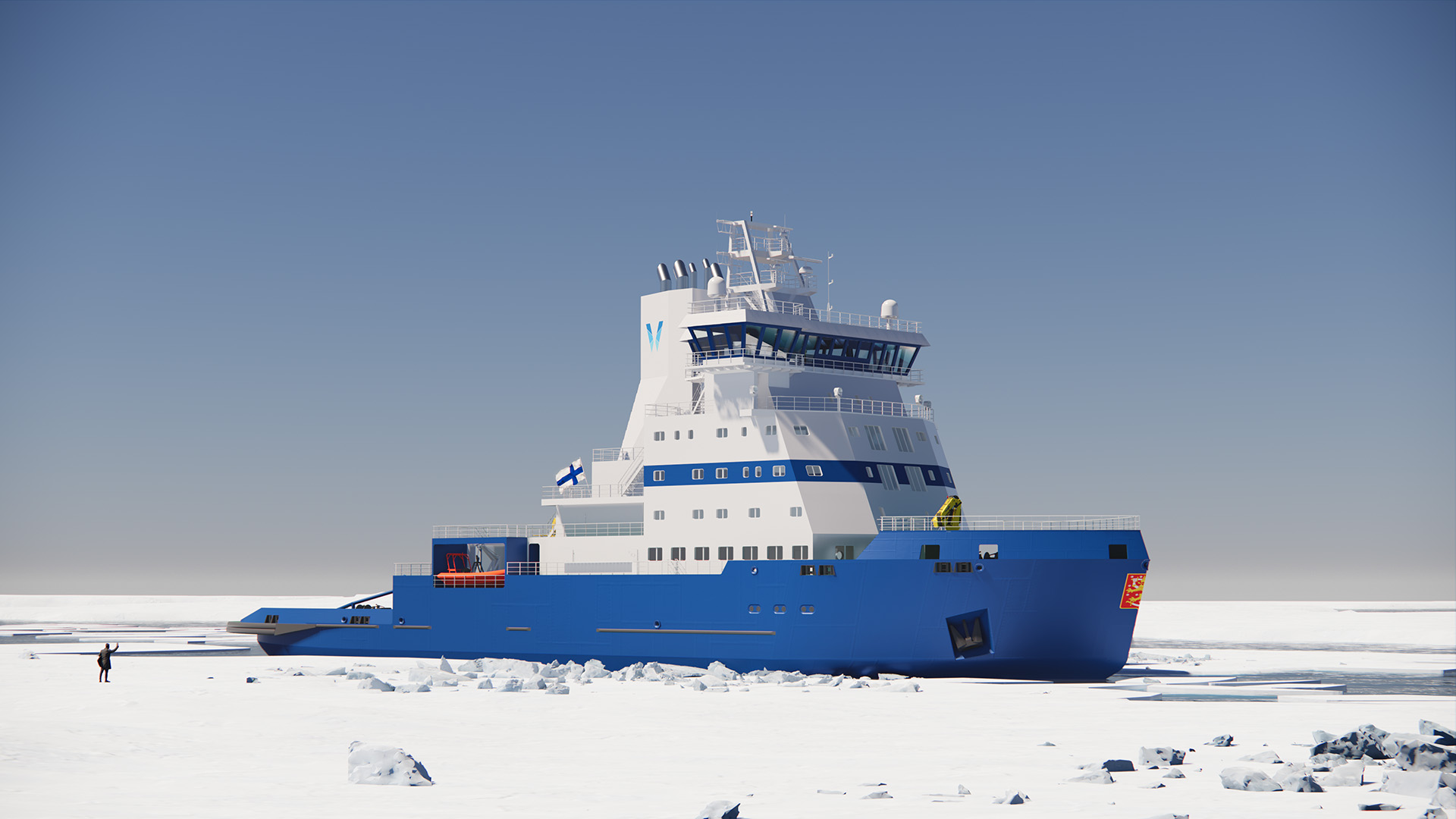
Image: Illustration of the new icebreaker.
The icebreaker is currently in the concept design stage, where the end users, designers and experts discuss and revise the design material and specification.
“The design deliberately revolves around user experiences. Besides models and drawings, it is important for us to hear how the end users experience our solutions. This is why icebreaker operators and electronics and automation experts are involved in the design process,” says Maritime Specialist Lauri Kuuliala from the Finnish Transport Infrastructure Agency.
Visibility from the bridge is a key consideration so that the operator can always see the towing fork, the assisted vessel, the handling of the tow cable and the stern deck crew. In addition, the location of the deck and machinery rooms and mess have been adjusted to better facilitate work in challenging conditions. Even minor solutions can affect work safety and flow.
“As the contractor, the Finnish Transport Infrastructure Agency has always had a very clear understanding of what kind of icebreaker is needed to replace the 70-year-old Voima. Our partners have praised the speed of our decision-making, which in turn has helped us stay on schedule,” says Head of Unit Helena Orädd.
There are two propulsion options at this stage; the decision will be made based on the best combination of performance and cost-effectiveness. This decision requires careful deliberation as the running costs will be spread across 50 years. According to the model tests, the performance of B+ is close to the legacy A-class icebreakers in conditions considered significant for the design. Naturally, emissions will be reduced compared to the retiring Voima.
The new icebreaker is designed for better seaworthiness in open water which it will encounter more frequently in the coming decades due to climate change. Nevertheless, demanding ice conditions and the need for icebreakers are expected in the future as well.
From bids to construction
Next year, the project will move from the design stage to shipyard invitations to tender. Negotiations with shipyards are already underway.
“The negotiations have been marked by openness and positivity – we have been able to discuss feasibility considerations directly. The drawings are relatively compact so that shipyards can keep the vessel to a competitive and optimised construction. Our principle is that the shipyard has some freedom in meeting the given capability requirements – space reservations, mounting, technical prerequisites and so on,” Lauri Kuuliala states.
Construction is set to begin in 2027, with completion scheduled for 2029. The construction is part of the WINMOS IV project, which has received EUR 42 million in CEF funding.