

Each card in poker is important, but their combination is what makes or breaks a game. The same applies to icebreaking. This article described the royal flush of icebreaking, consisting of the design and construction of icebreakers, their research, development and use, and the authorities’ contribution. Finland holds a wild card as well – its location.
Icebreaker design and construction
The history of icebreaker design and construction in Finland stretches back nearly a century. The first icebreaker in Finland, Murtaja was acquired in 1890; JM Sisu became the first icebreaker of all-Finnish construction in 1939. Since then, dozens of icebreakers have been completed in Finnish shipyards,
with construction peaking in the 1970s and 1980s. While most icebreakers built in Finland were destined for the Soviet Union, some saw domestic service or were exported to other nations. Of the icebreakers built in the 1970s, Urho and Sisu remain in service, as do Otso and Kontio from the 1980s.
Technical superiority was one factor in the Soviet purchase of several Finnish icebreakers – so what made Finnish icebreakers better? One answer lies in product development.
“Finland is a small country, which also works to our advantage. The designers and users of icebreakers as well as shipyards involved in their construction are constantly in touch. Close cooperation ensures that, for instance, any development needs are communicated forward. Such cooperation would be impossible in many other countries due to less connected organisations,” says teollisuusneuvos Reko-Antti Suojanen.
He has worked with icebreakers for approximately thirty years and believes that cooperation is a key Finnish strength.
The limited field of icebreaker design and construction has allowed Finland to occupy a unique niche, staying ahead thanks to decades of experience.
Finland is a pioneer in research
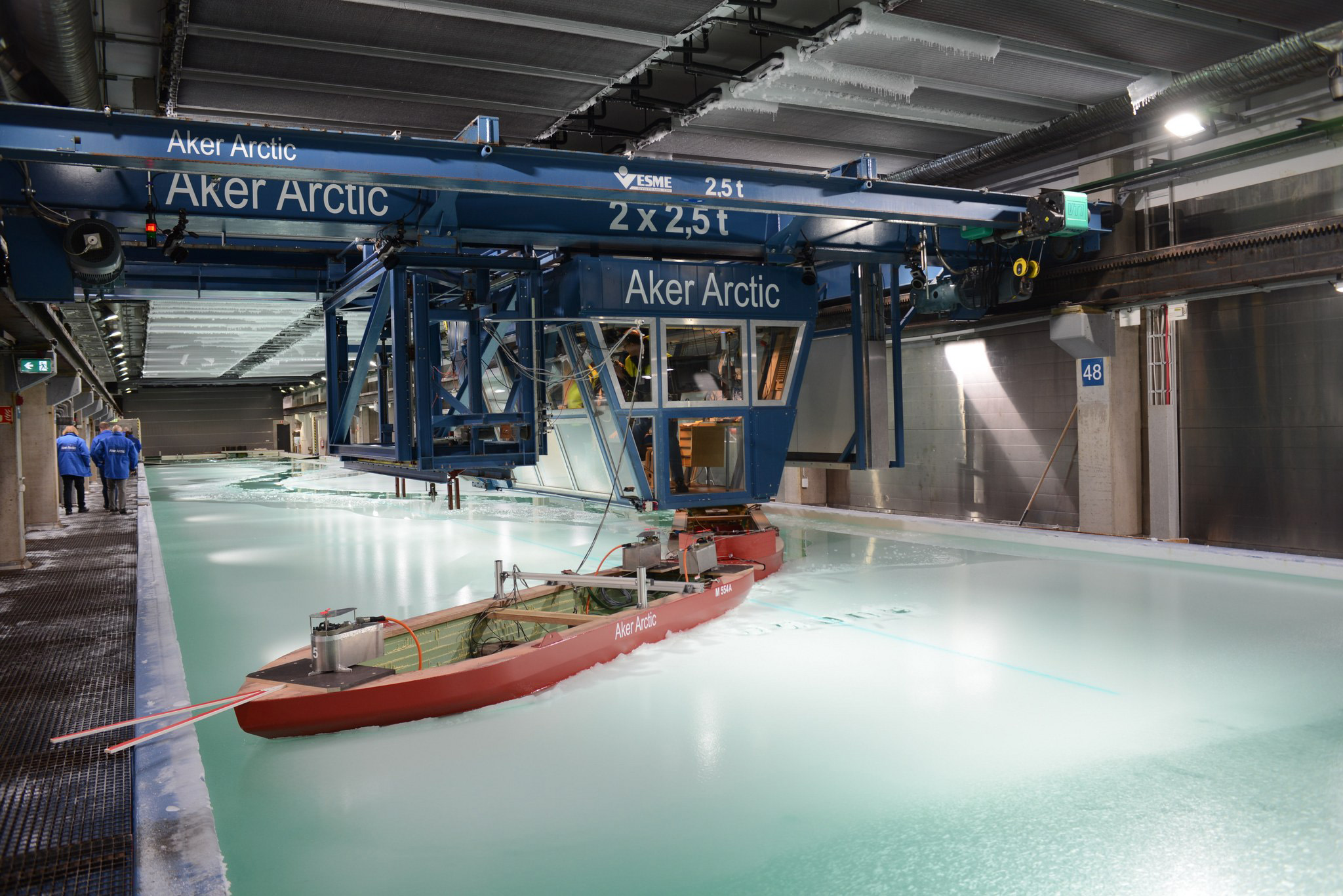
Globally, there are five ice tanks for icebreaker research and design, two of which are located in Finland: one in Otaniemi, Espoo, and the other in Vuosaari, Helsinki. These pools are used for various tests and for trialling concepts for new icebreakers.
Aalto University offers the Marine and Arctic Technology major subject focussing on winter marine navigation and icebreaking. Research supports technological development. In addition, education attracts young people to the field.
Icebreakers – and officials – at work
Icebreakers are tasked with helping other vessels to safely reach port. Icebreakers and their expert crews are the most visible part of this duty. Finnish icebreakers are operated by Arctia and Alfons Håkans.
Besides the vessels, officials play a crucial role in ensuring seamless icebreaking services. The Finnish Transport Infrastructure Agency is responsible for commissioned winter maritime transport duties and imposing assistance restrictions.
Finland and Sweden use jointly determined ice classes and assistance restrictions based on those ice classes. Some ports are off limits for vessels incapable of safe navigation through ice. Engine power and other factors affect the ice class of a vessel. The restrictions are designed to ensure smooth and safe winter maritime transport.
The wild card: Location, location, location
Other Nordic countries, such as Sweden and Norway, have perpetually ice-free harbours, whereas each Finnish harbour freezes almost every winter. Nevertheless, harbours are vital as the majority of international trade passes through them. Without icebreakers, Finnish logistics would literally freeze.
Finland is reliant on icebreakers due to geography, but this is not the sole reason why we are the global icebreaking superpower.
“Open and direct dialogue among parties involved in icebreaking has spurred Finnish success. Finland is a superpower in icebreaking because we treat icebreaking holistically: to us, icebreakers are not just ships to construct but a system that bring industrial parties, researchers, the authorities and international partners together,” Suojanen states.