
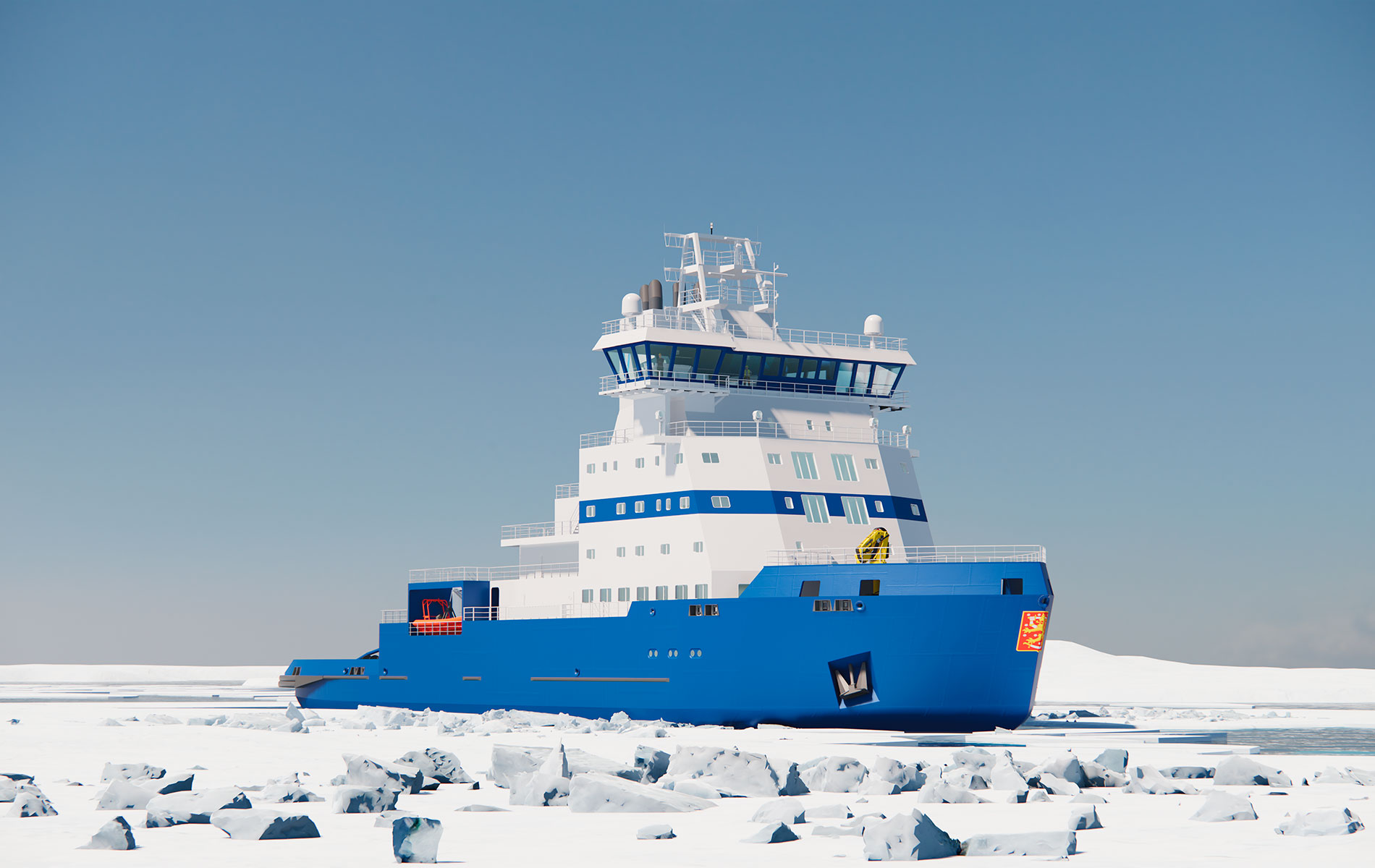
The performance of the propulsion solution was assessed on the basis of ice model tests carried out last autumn. Ice model testing is a well-established and reliable method of designing icebreakers to ensure the ice handling and manoeuvrability of the vessel before construction. The results are a key starting point for further design and construction of the vessel.
Chosen propulsion solution supports breaker's main functions
The propulsion solution chosen is reportedly the first of its kind and based on traditional straight shaft lines and rudders, complemented by a bow-mounted reversible rudder propeller. This combination substantially improves the vessel's manoeuvrability and ice-handling capabilities compared to rudders alone, while maintaining a technically clear and well-managed entity over its lifetime.
“This combination adds agility to the manoeuvrability of the vessel, while keeping the overall operation and maintenance simple and predictable. This is important for both operating and life-cycle costs," says Helena Orädd, Head of the Maritime Transport Unit.
The design has also considered alternatives where the thrust of the vessel would be distributed over several rotating units. Such solutions increase the agility of the vessel, but the additional benefit in terms of the main functions of a B+ class vessel would not have been commensurate with the increased technical complexity and cost.
"The propulsion solution clearly ensures adequate performance for the vessel’s functions in ice and open water. It is agile and reliable without being technically over-sized," says shipping expert Lauri Kuuliala.
The B+ icebreaker is capable of making a channel of about 25 metres in width, which is equivalent to the width of existing A-class icebreakers and will efficiently serve traffic requiring assistance. The efficiency of the operation is based above all on the quality of the channel, its continuity and the vessel's ability to move flexibly, including in open water under varying conditions. The requirement for open water performance is emphasised for the B+ icebreaker, as it is intended to be among the first icebreakers to start operating in the Bothnian Bay and to move to the Bothnian Sea and Gulf of Finland in harsher winters if necessary.
The new icebreaker will replace the 70-year-old Voima. At around 96 metres long and with 10.5 megawatts of engine power, the icebreaker will have the same power as the Voima, but will be much wider: the new vessel will be 24 metres wide, compared to the Voima's 19 metres. The increased beam and the modern hull and propulsion solution will significantly improve the vessel's open water characteristics and performance in icy conditions.
The next step is to invite tenders from shipyards for the project. Construction is scheduled to start in 2027. The construction of the icebreaker is part of the WINMOS IV project, which has received EUR 42 million in CEF funding. It should be ready in September 2029.
More information:
Helena Orädd, Head of the Maritime Transport Unit, [email protected]